
Borrowing Capacity Changes Explained

Updated: Jul 28
A Borrower's Guide to Understanding the Numbers
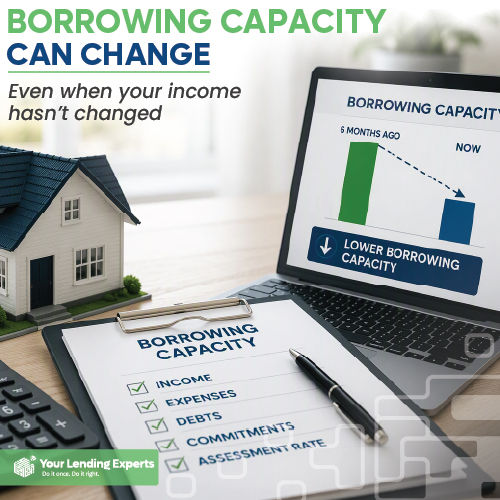
Many borrowers assume that if their income hasn't changed, their borrowing capacity should stay the same too. Unfortunately, that's not always how it works.
One of the most common questions we hear is:
"How come I could borrow more six months ago than I
can today when I'm earning exactly the same income?"
The answer is that borrowing capacity isn't determined by income alone. Lenders assess a range of factors when calculating how much they may be prepared to lend, and those factors can change over time—even if your salary never moves. Understanding what influences borrowing capacity can help you make informed decisions and avoid surprises when you're ready to buy, invest or refinance.
What Is Borrowing Capacity?
Borrowing capacity is an estimate of the amount a lender may be willing to lend based on your financial situation at a point in time.
While income plays an important role, lenders also consider:
✔ Existing debts
✔ Living expenses
✔ Credit commitments
✔ Interest rate assumptions
✔ Household size
✔ Loan term
✔ Lending policy
Because these factors are constantly changing, your borrowing capacity can move up—or down—even when your income remains unchanged.
Interest Rates Can Have a Big Impact
One of the biggest influences on borrowing capacity is interest rates.
When rates rise, lenders generally increase the minimum repayment amount they use when assessing affordability.
This means:
Higher assessed repayments
Reduced serviceability
Lower borrowing capacity
In some cases, even a relatively small shift in interest rates can reduce borrowing power by tens of thousands of dollars.
The opposite can also occur if rates fall or lender policies become more favourable.
Your Living Expenses Matter More Than Ever
Lenders are paying closer attention to spending habits than ever before.
If your everyday expenses have increased, your borrowing capacity may decrease—even if your income remains the same.
Common changes include:
Increased grocery costs
Higher utility bills
School or childcare expenses
Insurance premium increases
Additional discretionary spending
Even subscriptions and Buy Now Pay Later commitments influence the assessment.
This is why two people earning the same income can receive very different borrowing capacity results.
Existing Debt Can Change the Outcome
Have you:
Taken out a car loan?
Increased a credit card limit?
Opened a Buy Now Pay Later account?
Applied for personal finance?
Even if the repayments are manageable, lenders will generally include these commitments when calculating serviceability.
In some situations, a credit card with a high limit can reduce borrowing capacity significantly—even if you rarely use it or they have a $0 balance.
Different Lenders Assess Borrowers Differently
Not all lenders calculate borrowing capacity in the same way.
Each lender has its own:
Serviceability model
Expense calculations
Debt treatment policies
Lending preferences
This means your borrowing capacity may vary substantially between lenders.
A result from one lender doesn't necessarily represent what's available across the entire market.
Changes in Your Household Can Also Affect Borrowing Capacity
Life changes often affect borrowing power.
Examples include:
Having children
Becoming a single income household
Taking on care responsibilities
Supporting other family members
These changes don't automatically prevent you from obtaining finance, but they may alter how a lender views affordability.
Why a Borrowing Capacity Review Is Worthwhile
Many people rely on a borrowing capacity figure they received months—or even years—ago.
The reality is that borrowing capacity should be viewed as a moving target rather than a fixed number.
If you're planning to:
✔ Buy a home
✔ Purchase an investment property
✔ Upgrade to a larger property
✔ Refinance
✔ Access equity
A current assessment can provide a much clearer picture of what's possible today.
How We Can Help
At Your Lending Experts, we help borrowers understand not just how much they may be able to borrow—but what's influencing the result.
We take the time to:
✔ Review your current financial position
✔ Identify factors affecting serviceability
✔ Compare options across multiple lenders
✔ Explore strategies that may improve your position
Because the number that matters isn't what you could borrow last year—it's what opportunities are available to you now.
Ready to have your Borrowing Capacity Changes Explained?
If you're considering your next property move, refinancing, or simply want to understand where you stand, a borrowing capacity review can give you greater confidence and clarity before making any decisions.
Disclaimer: The content of this article is general in nature and is presented for informative purposes. It is not intended to constitute tax or financial advice, whether general or personal nor is it intended to imply any recommendation or opinion about a financial product. It does not take into consideration your personal situation and may not be relevant to circumstances. Before taking any action, consider your own circumstances and seek professional advice. This content is protected by copyright laws and various other intellectual property laws. It is not to be modified, reproduced or republished without prior written consent.
Borrowing Capacity Changes Explained


Comments