
Negative Gearing changes Borrowing Power

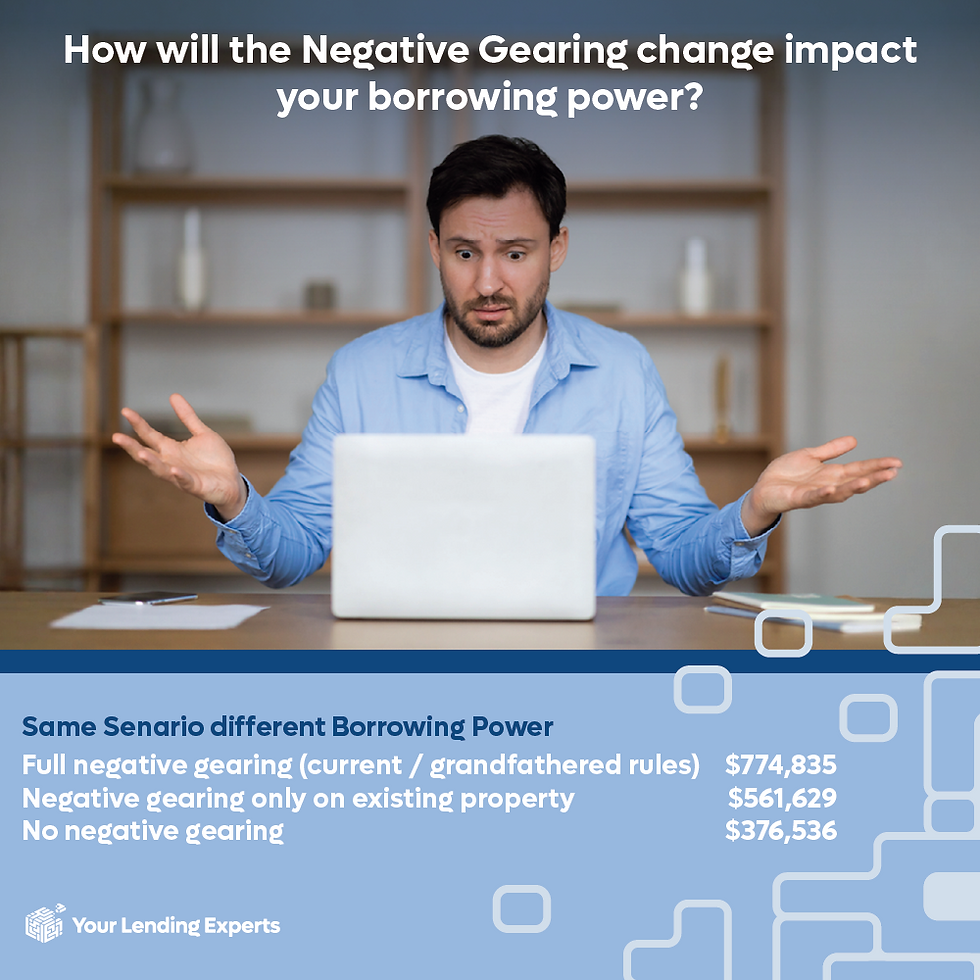
If you already own your home — and perhaps one investment property — you’ve probably seen the headlines about negative gearing changes.
But what do those changes actually mean for you?
Rather than talking in theory, let’s look at a fictitious example based on a typical client scenario we see every day.
The Borrower
Let’s take a borrower earning $105,000 per year who already owns an investment property and is now looking to purchase a second.
✅ Owns one investment property
✅ Considering adding another
✅ Stable PAYG income
✅ Modest Living Expenses and only a very small Credit Card Limit.
On the surface, this is a common and solid investment position.
The Properties
Existing Investment Property
Value: $800,000
Rent: $760 per week
Expenses: $350 per week
Loan: $600,000
Interest Rate: 6.00%
Term: 25 yrs remaining
Proposed New Investment Property (established property)
Value: $625,000
Rent: $600 per week
Expenses: $450 per week
Loan: $500,000
Interest Rate: 6.59%
Term: 30 yrs
This is a typical “next step” scenario — building a second income-producing asset.
The Big Question is how much can the borrow?
How much could this same borrower borrow under different negative gearing rules, with the same bank?
This is where things get interesting.
Here’s what the same borrower qualifies for under different scenarios:
Scenario | Borrowing Power |
✅ Full negative gearing (current / grandfathered rules) | $774,835 |
⚖️ Negative gearing only on the existing property | $561,629 |
❌ No negative gearing available | $376,536 |
Note: The same lender was used for each example. Different lenders apply varying policies when assessing negative gearing. This comparison illustrates how borrowing power can change due to negative gearing, with all other aspects of the scenario remaining consistent at the same lender.
What Does That Really Mean?
The difference is substantial:
🔻 Nearly $400,000 less borrowing capacity with no negative gearing
🔻 Over $200,000 reduction even with partial changes
In practical terms, this could mean:
Not being able to purchase the same property
Delaying your next investment, choosing to build instead of buying established giving you access to negative gearing
Or needing a completely different strategy
Why Does This Happen?
Under current rules, negative gearing allows:
Rental losses to reduce taxable income
Which improves your overall financial position
And can support higher borrowing levels
Under the proposed changes:
Losses on new properties may not offset your salary
Lenders assess your position more conservatively
And borrowing capacity can drop significantly
What This Means for Established Investors
If you’re in a similar position — owning one property and looking to build a portfolio — the key takeaway is:
The impact is not on what you already own — it’s on your next move.
Your existing property:
May still retain its current tax treatment
Your next purchase:
May need to stand on its own cash flow or you may need to look at building an investment property instead of buying an established property.
Will Strategy Need to Change?
For many of our clients, the answer is yes — but not dramatically.
We will see a shift toward:
More focus on cash flow and rental yield
Greater consideration of new builds
Careful structuring of loans and deposits
Running the numbers more thoroughly before committing
The fundamentals of good investing still apply — but the margin for error becomes smaller.
What We’re Advising Clients Right Now
Using scenarios like this, our conversations are focused on:
✅ Whether it still makes sense to purchase now or later
✅ How much borrowing capacity may change under new rules
✅ Structuring loans to optimise flexibility
✅ Ensuring long-term affordability — not just tax outcomes
Because ultimately:
It’s no longer just about tax strategy — it’s about borrowing strategy.
Thinking About Your Next Investment?
If you're considering purchasing another property, now is the time to understand how your borrowing power could change.
Even a quick scenario analysis — like the one above — can provide clarity before making your next move.
Disclaimer: The content of this article is general in nature and is presented for informative purposes. It is not intended to constitute tax or financial advice, whether general or personal nor is it intended to imply any recommendation or opinion about a financial product. It does not take into consideration your personal situation and may not be relevant to circumstances. Before taking any action, consider your own circumstances and seek professional advice. This content is protected by copyright laws and various other intellectual property laws. It is not to be modified, reproduced or republished without prior written consent.


Comments